PostgreSQL
The PostgreSQL Producer is a persistence code generator: it translates a CodeFluent Entities model into a database running on PostgreSQL Server 8.4 and upper. The database is created by generating SQL scripts which are then automatically ran on the configured server.
Prerequisites
.NET
The PostgreSQL Producer relies on the Npgsql2 library, version 2.0.11. CodeFluent Entities requires the Npgsql assembly.
OSSP
The producer also requires the libossp-uuid package to be installed on the server.
Windows
Please note that libossp-uuid is shipped with the Windows PostgreSQL 8.4+ standard installation package.
Linux
You need to install the postgresql-contrib package.
Generate PostgreSQL persistence layer
The PostgreSQL Producer is implemented by the CodeFluent.Producers.PostgreSQLProducer class, contained in the CodeFluent.Producers.PostgreSQL assembly.
The PostgreSQL Producer is available in the Persistence Layer Producers section of the Add New Producer window.
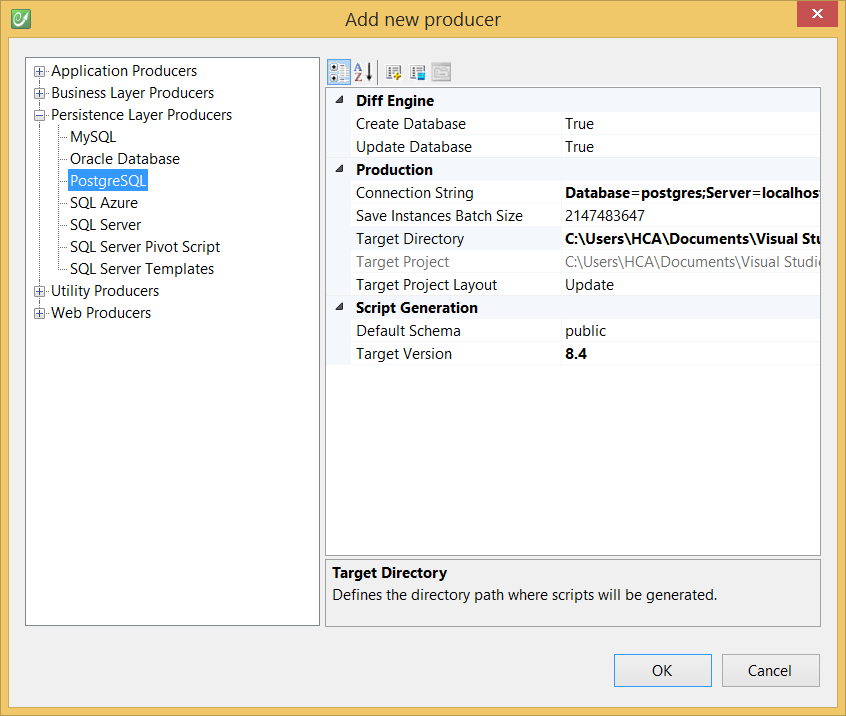
Which will generate scripts like this:
CREATE OR REPLACE FUNCTION "public"."Customer_Delete"
(
    "#Customer_Id" uuid,
    "#_rowVersion" bytea
)
RETURNS void
VOLATILE
CALLED ON NULL INPUT
AS $$
DECLARE
    "cf_refcursor" refcursor;

BEGIN
    DELETE FROM "public"."Customer"
        WHERE (("Customer"."Customer_Id" = "#Customer_Id") AND ("Customer"."_rowVersion" = "#_rowVersion"));
    IF NOT FOUND THEN
        RAISE EXCEPTION 'CodeFluent Runtime: Concurrency error';
    END IF;

END;
$$ LANGUAGE plpgsql;
//
//
Application configuration
You need to configure the generated classes to use PostgreSQL as persistence layer (persistenceTypeName) and set a connection string indicating them where to connect to (connectionString). Here's a sample configuration for a sample application named Northwind:
<configSections>
  <section name="Northwind" type="CodeFluent.Runtime.CodeFluentConfigurationSectionHandler, CodeFluent.Runtime" />
</configSections>
<Northwind persistenceTypeName="PostgreSQL"
           connectionString="Server=localhost;Database=PostgreSQL_Test;User Id=postgres;Password=yourpassword;"
           postgresql-defaultSchema="public"
           postgresql-useParameterCache="true" />
Notes: postrgresql-defaultSchema and postgresql-useParameterCache are optional and their respective default values are "public" and "true".
The default schema defines the schema to be used when an entity doesn't have a schema. By default, the "public" schema is used.
The postgresql-useParameterCache attribute allows you to disable the use of the parameter cache system which stores lists of parameters for each stored procedure that is used.
Supported features
The following features are supported:
- Generating schemas and cross-schemas relations
- Generating tables
- Generating constraints (primary keys and foreign keys)
- Generating sequences for auto-incremented columns
- Generating views
- Generating stored procedures (using SQL or PL/pgSQL)
- Generating instances
- Saving instances
- Saving Binary Large Objects (BLOB) instances in bytea columns
Unsupported features
CFQL Search methods
Special cases
Binary Large Objects (BLOB) management
Any binary large object defined in the model is stored in PostgreSQL in fields of type bytea, which implies a max size of 1GB per object.
Creating raw methods
You can only write your raw methods in PL/pgSQL. Other languages are not supported.
PL/pgSQL Functions
By default, if your method is returning something, the generated stored procedure skeleton will return a refcursor. The return type can be changed through the customReturnType attribute on the method. By default a refcursor named cf_refcursor is declared before opening the BEGIN...END; block of the procedure, and returned before the end of this block. It is up to you to return another refcursor in your raw code.
If you need to declare more variables in the DECLARE...BEGIN block, you can do it through the customVariables attribute.
Example of a load() raw function
This method loads all the instances of the Employee entity. It has no other interest than to demonstrate how to create a simple raw function:
LOAD() RAW
OPEN cf_refcursor FOR SELECT * FROM "public"."Employee";
In this case, since the return type is not customized, there is no need to return manually cf_refcursor at the end of the procedure. The RETURN statement will be added automatically by the producer.
Differential engine (experimental)
The differential engine of the PostgreSQL Producer always reconstructs all the constraints, sequences, views and functions of the database. The differential logic is only executed on schemas, tables and instances that are either created or modified in the model. Instances are restored to the model value, had they been modified.
Deleted columns
By default a column which exists in a table in the database but does not exist in the model is automatically dropped by the producer. This feature can be disabled in the configuration by setting the Drop deleted properties field to False.
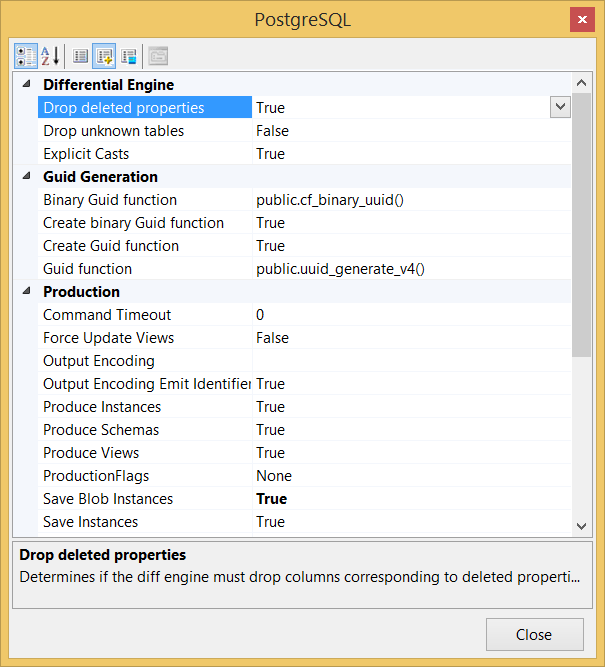
Deleted tables
If a table is defined in the databse but not in the model, it is not dropped by default. This means that relations tables belonging to deleted Many-To-Many relations will be kept although the matching relation has been deleted from the model. If you wish the differential engine to clean-up after you, set its Drop unknown tables property to True.
Note: Unknown tables are not deleted by default as you might be working in a schema that already contains tables unrelated to your model. In such case activating this feature would cause all unknown tables to be deleted.
Type casts
When modifying the type of a property, the differential engine will automatically cast the existing column to the new type. If the Explicit Casts setting is set to True (which is the default value), the differential will use the SQL instruction CAST(sourcetype AS targetype). If you are intending to change a column's type to an incomptible type, you can create a specific cast procedure using the CREATE CAST instruction.
Sequences
Sequences of identity columns are automatically dropped and rebuilt by the differential engine at each generation.
Target versions
Starting from PostgreSQL 8.4, all upper versions are supported. Default target version is PostgreSQL 8.4.
Notes about PostgreSQL 8.4
PostgreSQL 8.4 does not support anonymous blocks (see the DO instruction). All the PL/pgSQL scripts are imbricated in a function that is sequentially created, executed, and then dropped.
PostgreSQL 8.4 does not support collation.
Notes about PostgreSQL 9.0
PostgreSQL 9.0 does not support collation.